Reviews
Evolution (2026)
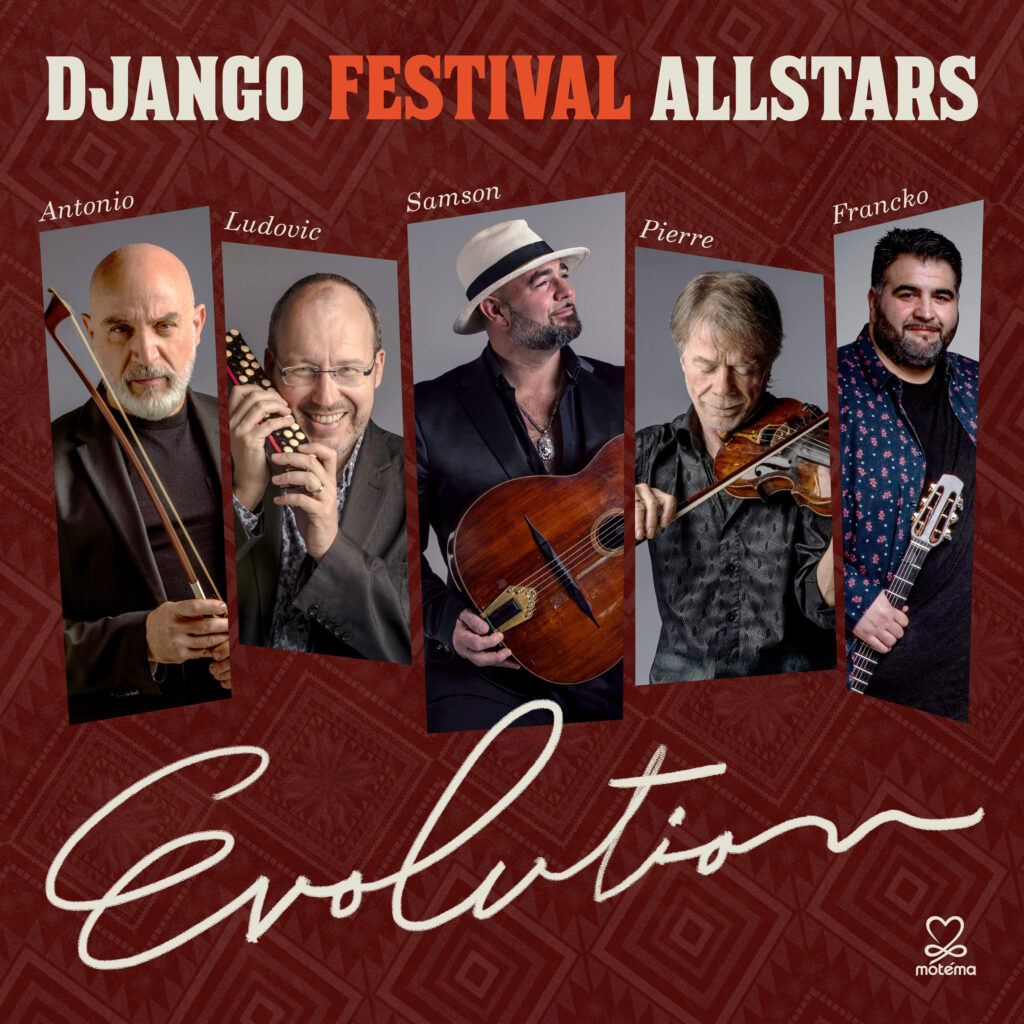
“Gypsy Jazz for the 21st Century”
“Quite magnificent! … brings together luminaries Samson Schmitt, Pierre Blanchard, and Ludovic Beier.” [album of the day 2/13/2026]
4-Stars! “Luminous… reaffirming that Manouche jazz, when played with conviction and humility, remains one of the most vital in modern acoustic music..” (Pierre Giroux)
“Surely the best Gypsy Swing band in New York, Paris, or anywhere… Every composition, every solo, and every ensemble passage on Evolution sings with joie de vivre.”
Keeping the flame of Gypsy jazz alive.” … “While no Django compositions appear on this new album, his spirit is everywhere: the wild energy of Gypsy virtuosity… the fraternity of the gathering in a circle, the mixture of tenderness and optimism, of nostalgia and indolence that Django brought to jazz.”
A work of genuine distinction… refreshes the genre without betraying its roots.”
“Gypsy jazz with an urban edge…whilst respecting tradition [the Allstars’ EVOLUTION] swaps the horse drawn caravan for a supercharged Renault.”
“Among the most influential international ensembles in modern Gypsy Jazz” … “[Evolution] demonstrates that this style is not static, but rather continuously evolves and inspires new generations of musicians. Precision, a joy of playing, and stylistic maturity characterize a release that productively blends tradition and contemporary elements”
“A luminous and excellent album… as they march through intricate melodies and improvised riffs at top speed, you will find yourself tapping toes, snapping fingers, or dancing like nobody’s watching.”
Downbeat (Interview) / Cree McCree / March 2026
Paris Move / Thierry De Clemensat / February 2, 2026
Jazz Views / Tim Larson / February 12, 2026
Bebop Spoken Here / Lance Liddle / February 15, 2026
The Blade (Toledo) / Tom Henry / February 12, 2026
Making a Scene! / Dee Dee McNeil / February 8, 2026
Jazz Music Archives / February 13, 2026
Jazz Nicknames / March 1, 2026
Downbeat
Cree McCree
March 2026
“Evolution is aptly named because it moves Django Reinhardt into the 21st century. It’s also been described as ‘Django meets Miles, Charlie Parker and Herbie Hancock at the Allstars House Party.’”
Django Reinhardt, the seminal Manouche Romani guitarist who electrified pre-War Paris with his hot gypsy jazz interpretations of American jazz, is an almost mythical figure. In 1928, while traveling in a gypsy caravan wagon, he knocked over a candle and severely burned the ring and pinkie fingers of his left hand, which guitarists use to play the fretboard. But instead of abandoning the guitar, he simply adapted his style and used his other two fingers. By reinventing his fret work, he created a unique style of playing that inspires other guitarists to this day.
Django’s spirit lives on in the Django Festival Allstars, whose latest album, Evolution (Motema), marks the 25th anniversary of the annual Django Reinhardt NY Festival and features all-original tracks of the ensemble’s nouvelle gypsy swing.
Led by Manouche Sinti guitarist Samson Schmitt, son of the Allstars’ legendary founding guitarist Dorado Schmitt, the current lineup features accordion virtuoso Ludovic Beier, who also plays the accordina, an accordion/harmonica hybrid; French violin maestro Pierre Blanchard; bassist Antonio Licusati; and Manouche rhythm guitarist Frankco “Locomotive” Mehrstein, whose nickname captures his propulsive style.
Late last year, Beier, Blanchard and Lucasati spoke with DownBeat, checking in from Paris via Zoom, to discuss the new album. Allstars manager Pat Philips, founding director of the Django Reinhardt NY Festival, joined as well, from New York. The lively conversation covered everything from the group’s Manounche heritage to its mission to bring Reinhardt’s legacy into the 21st century on Evolution.
The conversation has been edited for length and clarity.
Cree McCree: I’d like to start out by clarifying exactly what a Manouche gypsy is.
Ludovic Beier: Manouche means “free man,” and gypsies have been travelers since they migrated west from India to Europe. They travel with a caravan and the world is their hearth. And if you aren’t born into the culture, you’re a gadjo. If you are gadjo, you respect the community and listen carefully to what they play. And once you’ve been accepted, you’re like family for life. When there’s no ego on stage, it’s easy to play with no score and know exactly what to do.
Pierre Blanchard: And it’s not only Manouche. I also have some gypsy roots. My grandfather was also a violin player, and lived the same kind of life and traveled all the time in the same areas as the Manouche Gypsy people.
Beier: If Samson were here, he would tell you that the guitar has been part of his life since he was 3 years old, when he started playing rhythm guitar with his father, Dorado Schmitt. For the Manouche community, Django is much more than an idol. He’s part of their culture. Samson was raised in this tradition, but because he is 45 years old, he’s also been influenced by guitarists like George Benson, Pat Metheny and Carlos Santana. So he’s opening the Django tradition in more directions.
Blanchard: Samson is also a fine composer and a very talented arranger of music. They’re all very talented, and put their own take on the original music on the album.
McCree: Evolution is aptly named because it moves Django Reinhardt into the 21st century. It’s also been described as “Django meets Miles, Charlie Parker and Herbie Hancock at the Allstars House Party.” If that actually happened, what would Miles, Charlie and Herbie bring to thm the mix?
Beier: You should ask Herbie what he thinks about that. [laughs] We all grew up in the jazz tradition, and many of those influences came after Django’s death. It’s a shame that Django never met any of those musicians when he was in New York in the early ’40s. But the music continued to advance and develop, and the title Evolution reflects that progression.
McCree: The great Belgian harmonica player Toots Thielemans was a big influence on you, Ludovic, and you give him a shoutout on one of the tracks.
Beier: Toots wasn’t just a great musician but also a very great person. And when he passed, I decided to write something. “Around Toots” isn’t a tribute from Ludovic to Toots. It reflects all the inspiration that Toots gave to the world.
McCree: I also love the accordina, the accordion/ harmonic hybrid you play.
Beier: That instrument was originally created as an alternative to accordion, so players could carry a small instrument to practice on in the train. It was not a big success initially. But 40 years later, after some musicians started to play jazz accor-dion, it took off and is now being used in lots of different styles of jazz. But my own main influence continues to be Toots, because of what Toots could do with the chromatic harmonica.
McCree: With such a wealth of great original material, how did you decide what tracks you wanted to put on the album?
Beier: It was difficult because everybody composes songs. So we decided to make the album a reflection of what we do onstage live. Pierre has one of the most iconic tunes on the album, “Balkanic Dance,” which we always play live. And we also made sure that everybody liked whatever made the cut.
McCree: Pat, how did the Django Reinhardt NY Festival first come about?
Pat Philips: I started it in 2000 at Birdland in New York City with my late husband, Ettore Stratta, who had worked with Django’s founding violinist Stephane Grappelli for many years. When he passed away we held a memorial concert at Carnegie Hall. We had many great artists, but when the Django Reinhardt trio with (gypsy jazz guitarist) Jimmy Rosenberg appeared onstage, the audience went wild. Backstage, while this was all happening, we said, let’s start a Django Festival. And so we did.
McCree: What can people expect from seeing the Django Reinhardt Allstars Festival tour this year?
Philips: We always have a guest artist with us, and we’ve had so many wonderful ones. This past tour we had Veronica Swift, the great jazz singer, for the first time, and she was a wonderful addition to the program. This fall we will have a different artist every night, which gives the musicians an opportunity to meet them, to be inspired by them. And vice versa. They show up about an hour before the show and go backstage. And Samson may sit down with the guitar and run a few things by them, and voila! They get on the stage and and a certain kind of magic happens.
McCree: What would you most like people to take away from the experience of listening to Evolution?
Beier: I would like people to listen to the album from the first song to the last song, and travel into our music. I remember when I was a kid my parents bought a CD player for me, and I had only one CD to listen to. So I listened to it from the beginning to the end maybe 10 times. And I think today, many people just listen to one song for 30 seconds, and then switch. So my advice is, please, just relax, put the album on and pour a glass of something, whatever it is, and listen to the music from the beginning.
McCree: It’s a journey.
Beier: Yes. It’s a journey, of course.
—Cree McCree
“The sheer quality of the musicianship and forward-looking arrangements elevates this recording into a work of genuine distinction…”
When Django Meets Miles: The Django Festival Allstars Reinvent Gypsy Jazz for the 21st Century. I am not usually impressed by albums of this kind. Too often, they lean on nostalgia or virtuosity as an end in itself. Here, however, the Django Festival Allstars make a compelling case for something far more ambitious. The sheer quality of the musicianship, paired with unusually thoughtful and forward-looking arrangements, elevates this recording into a work of genuine distinction, situated between Gypsy jazz and folk-jazz, and shaped into a form of fusion that feels both graceful and purposeful.
At its core, the Django Festival Allstars represent a modern answer to a historic question: what does Gypsy jazz sound like when it refuses to fossilize? Founded in 2002 and led until 2018 by the Gypsy jazz legend Dorado Schmitt, the ensemble stands as a 21st-century response to the revolutionary Hot Jazz forged by Sinti guitarist Django Reinhardt and violinist Stéphane Grappelli with the Quintette du Hot Club de France, whose sound captivated Paris in the 1930s and 1940s. That earlier movement marked Europe’s first true reply to American jazz, a dialogue across the Atlantic that continues, in refined form, with the Allstars today.
Ludovic Beier, founding member and de facto spokesperson for the group, puts it plainly: “Reinhardt’s Hot Gypsy Jazz was Europe’s first response to American jazz. We respect Django’s immense legacy while allowing the music to evolve, exactly as Django himself would have wanted.”
That philosophy is audible throughout Evolution, an album shaped through dozens of live performances before the group entered the studio in 2024. The result is not merely polished but deeply internalized. The Allstars play with a conviction that recalls why jazz singer and drummer Grady Tate once remarked of them: “These are true masters of the stage, capable of accomplishing the impossible on their instruments.” If anything, the album suggests that Tate’s praise underestimated the scope of their ambition.
What distinguishes this project is not only its technical brilliance but its refusal to stay within stylistic borders. The group reinvents both form and substance, drawing inspiration as readily from Argentine music as from swing, bebop, cool jazz, and even hints of jazz-rock. The listener is continually surprised by a sonic palette that refreshes the genre without betraying its roots. This stands in stark contrast to the commercially driven Gypsy jazz groups that proliferated in the 1990s and early 2000s. Here, the music is guided by reflection rather than formula.
That reflection translates into arrangements of rare quality, modern, layered, and unusually deep for a style that has too often relied on tradition alone. In that sense, Evolution addresses what has long been missing from this music: a willingness to interrogate its own language and expand it without losing its identity.
The personnel assembled for this project only strengthen that vision. Samson Schmitt, an exceptional lead guitarist who has inherited the mantle of his father, combines fire with restraint. Ludovic Beier proves himself a singular improvisational voice on accordion and accordina. Violinist Pierre Blanchard, who joined the group in 2006, brings a breadth of stylistic fluency that allows the music to move seamlessly across genres. Together, the soloists navigate harmonic shifts with impeccable articulation, narrative expressiveness, and structural clarity.
They are supported by a rhythm section of uncommon authority: bassist Antonio Licusati, whose expansive tone anchors the ensemble, and rhythm guitarist Francko “Locomotive” Mehrstein, a cousin of Schmitt, whose propulsion generates an irresistible swing. The collective harmonization is subtle yet powerful, underscoring a group aesthetic that privileges cohesion over individual display.
“We play fast and loud, not out of competition, but because it’s part of our aesthetic,” Beier explains. “The Gypsy essence is always present, but our 21st-century experience is just as essential.” On tracks like Swing and Ready, a traditional theme is reframed through a modal approach to soloing, balancing swing-era roots and Gypsy heritage while introducing new phrasing drawn from bebop and cool jazz, occasionally flirting with jazz-rock textures.
For the Allstars, this synthesis defines the very idea of Evolution. As Beier memorably puts it: “Django meets Miles, Charlie, and Herbie at a party hosted by the Allstars.” It is an image that captures the project’s spirit with unusual precision.
Beyond the undeniable artistic performance lies an intellectual engagement with the music itself, an inquiry into what Gypsy jazz is and what it must become if it is to remain vital. Such an ability to renew oneself is the hallmark of the greatest artists. The obvious comparison is Miles Davis, whose multiple creative reinventions reshaped jazz repeatedly over the course of a single lifetime. While Davis was a singular case, the Allstars operate in that same spirit of restless evolution.
The Django Festival Allstars thus represent more than an accomplished ensemble. They embody a renaissance of a style and a reawakening of an art form, delivered with a sensitivity that is likely to move listeners through the sheer quality of its interpretations. Over the years, dozens of major jazz figures have collaborated with the Allstars at the Birdland festival, among them Grady Tate, James Carter, Randy Brecker, Cyrille Aimée, and Madeleine Peyroux. After hearing Evolution, it becomes abundantly clear why so many artists have been drawn into their orbit.
Thierry De Clemensat
Member at Jazz Journalists Association
USA correspondent for Paris-Move and ABS magazine
Editor in chief – Bayou Blue Radio, Bayou Blue News
PARIS-MOVE, February 2nd 2026
“these are some of the finest Gypsy swing musicians anywhere, deeply rooted in tradition but unafraid to push it forward.”
Evolution opens with a Gypsy swing band firing on all cylinders. Tempos are brisk, lines dart and leap across the instruments, and the ensemble responds to each phrase with quick, instinctive interplay. The swing is unmistakable, but the textures are richer than a typical guitar-and-violin front line—accordion and violin carry much of the melodic weight, while guitar shifts seamlessly between lead and accompaniment.
What stands out is how clearly each voice is defined. The rhythm guitar and bass lay down a steady pulse, but they also leave space when needed, giving the soloists room to stretch. Fast tunes are packed with notes and precision, while the slower pieces lean into softness—long tones, sustained notes, and quietly shaped melodies.
At fast tempos, the Django Festival Allstars stay remarkably clear and coordinated. The rhythm guitar and bass lock into a tight pulse while violin and lead guitar fire off rapid, sharply defined lines, each solo landing cleanly before the band snaps back to the theme. “Casse Noisette” makes that control impossible to miss.
Speed is part of the Allstars ’identity, but Evolution is just as compelling when the band slows down. On “Around Toots,” a tribute to Toots Thielemans, Ludovic Beier’s accordina takes center stage, its reedy, breath-like tone floating above bass and rhythm guitar. Samson Schmitt’s guitar solo lets notes resonate in space, understated and emotional, before the accordina returns to close the tune quietly in a moment of real tenderness.
There’s a gentle, swaying rhythm, the pulse soft but steady as guitar, violin, and accordion take turns shaping long, drawn-out phrases. The melody arrives almost in a whisper, each line measured to let the emotion unfold naturally. That intimacy comes through on “Lovely Wife,” one of the album’s most romantic and unhurried moments.
When the band flips back into high gear, they do it with precision and energy. On “Swing and Ready,” a thumping bass and percussive accordion set a tight foundation while the lead guitar bursts into fast runs, weaving in triplets and single-note lines up and down the neck. The violin darts through the upper register, bowing rapid phrases that thread around the other instruments, and the groove never loosens its grip.
“Piazza Italia” opens with the lead guitar plucked harder than usual, each note sharp and staccato, while the rhythm guitar strums furiously alongside. The accordion slips in, echoing and perfectly answering the guitar’s urgent, darting lines. The rhythm section keeps the pulse steady, reinforcing how conversational this band can be at any tempo.
Late in the album, “Stenli” brings the accordina back into focus, its unique color threading through violin and lead guitar as they trade solos that leap from low-register runs to bright upper-register lines. The rhythm guitar taps out a rimshot-like pulse while the bass anchors the groove. By the time the tune fades, it’s clear: these are some of the finest Gypsy swing musicians anywhere, deeply rooted in tradition but unafraid to push it forward.
The Django Reinhardt NY Festival was founded at Birdland in 2000 and the Festival Allstars made their debut two years later. Both the band and the festival are still going strong.
Although both organisations were inspired by the recordings of Stéphane and Django in 1930s Paris, they are not caught in a time-warp. Playing compositions by Schmitt, Beier and Blanchard that whilst respecting tradition swaps the horse drawn caravan for a supercharged Renault resulting in gypsy jazz with an urban edge.
I’m not normally a lover of accordions but Beier’s dexterity on the instrument is such that I could only respond with “Chapeau monsieur!”. He also blows the accordina, which is an instrument not unlike a melodica, on which he pays tribute to the late harmonica virtuoso Toots Thielemans with his own composition, Around Toots.
Schmitt and Blanchard on guitar and violin do their worthy forebears justice with Licusati and Mehrstein solid in support.
If your thing is manouche, gypsy jazz, then this is for you, it was released last Friday on the Motéma label. Lance
First, a word about the late Django Reinhardt, the Belgian-born guitar whiz who died in 1953 and spent most of his life in France establishing himself as a master of the so-called Gypsy Jazz style of music.
It’s amazing that, 73 years after his death, people are rediscovering his greatness.
But it’s also not in the sense of the legacy Reinhardt left behind. Frankly, after getting to know more about his style, I’m kind of at a loss for words why more people don’t know about it.
It’s that good, wavering between a feel-good vibe and deeply moving melodies. I’m a big fan.
The best example of Reinhardt’s influence in the Toledo-Ann Arbor-Detroit triangle is with a group called Djangophonique, led by super-talented guitarist Andrew Brown.
Now comes the fifth album by this super group, the Django Festival Allstars, and it’s a beaut.
Due to be released Friday on the Grammy-winning Motema label, the Django Festival Allstars have been around since 2002 but recently underwent a couple of personnel changes.
Samson Schmitt inherited the role of lead guitarist from his father, founding leader Dorado Schmitt. Samson’s rapid-fire picking and his obvious love of Reinhardt’s guitar style really comes through.
The group also includes Pierre Blanchard on violin, Antonio Licusati on bass, and Francko Mehrstein on rhythm guitar, but perhaps the most distinctive sound outside of the trademark Django Reinhardt guitar style is what Ludovic Beier adds on accordion and accordina.
Django Festival Allstars produce a type of all-original “nouvelle Gypsy Jazz” that is pleasant, infectious, and exciting. It grabs the listeners from the opening song that Samson Schmitt wrote, “Rire Avec Charlie,” and doesn’t let go.
Schmitt is credited for writing six of the album’s 12 songs. Bandmates Beier and Blanchard each wrote three.
Each honors the legacy of Reinhardt while adding a modern touch.
The group’s name is inspired by the Django Reinhardt NY Festival.
“Reinhardt’s Hot Gypsy Jazz was the first answer to American jazz in Europe. We respect Django’s giant legacy while moving the music forward, which Django would have wanted,” Beier, a founding member, said.
Django Festival Allstars bring the world an album of all-original, Django-inspired, gypsy jazz. This brilliant group of musicians first emerged from the Django festival held in 2002. Although the personnel has changed, the dedication and excellence has only continued to grow. The Django Reinhardt NY Festival itself was founded in 2000. They celebrates 25-years of excellence this year.
Here is a luminous and excellent album that keeps alive the spirit of Django’s incredible music, while spotlighting five musicians who bring that music alive. The festival has released five albums prior to this one. The first was “Live at Birdland” (2001), “Gypsy Swing” (2006), “Live at Kennedy Center” (2012), “Live at Birdland” (2013), and in 2018 they recorded and released their first studio album. Now, 25-years of evolution continues to celebrate and expand on Django’s musical inspiration in this next-generation of ‘Allstars.’
In spite of leadership changes that happened in 2018, the loss of a band member in 2023, and the addition of essential new players, this ensemble of excellence emerges with tightened bonds and worldwide bookings. Samson Schmitt inherited the role from his talented father and is the lead guitarist with the group. Track #5, that celebrates Toots Thielman on a tune composed by Ludovic Beier (their accordion master), “Around Toots” spotlights Schmitt’s wonderful guitar talents. This is a beautiful ballad that squeezes every note of beauty out of this composition.
Pierre Blanchard’s violin dances and soars on Schmitt’s composition “Lovely Wife.” But it’s the pulsating rhythm and haunting melody of “El Destino” that warms the heart and fills my listening room with the spirit of Django’s musical style.
These musicians bring Pierre Blanchard’s tune alive on the energy driven “Dorado’s Smile.” These up-tempo numbers bring joy and excitement to my heart and soul.
Each of these group members bring awesome talent to the bandstand. Three of them shine brightly as superb composers on this project. Bassist Antonio Licusati pumps the groove forward like a freight train. Francko Mehrstein’s rhythm guitar locks hand in hand with Licusati’s bass and the song, “Swing and Ready” storms ahead, wrapping me up in its energy and excitement.
This 21st Century band of “Django Festival Allstars” may have changed some of the musical participants, but they continue to constantly evolve and compliment the inspired style and music of Reinhardt. As they march through intricate melodies and improvised riffs at top speed, you will find yourself tapping toes, snapping fingers, or dancing like nobody’s watching.
Reviewed by Dee Dee McNeil
Jazz Music Archives
The thrilling Django Festival Allstars, currently on tour with Veronica Swift to celebrate 25 years of the Django Reinhardt NY Festival, are excited to announce a new chapter in their fabled history. After a change in leadership in 2018, recovering from the loss of a band member in 2023, and the addition of an essential new player, the group has emerged revitalized. Having tightened personal bonds within the group and committed to expanding touring beyond their established North American circuit, they landed a multi-album deal with the GRAMMY®-winning Motéma label and teamed up with a world-wide booking agency. It’s all part of the EVOLUTION they are celebrating with the February 13, 2026 release of the Festival’s fifth album, and the Allstar’s second quintet studio recording of timeless, all-original ‘nouvelle Gypsy Jazz’.
Soulful, kinetic and brilliant, the Django Festival Allstars ensemble, led by Manouche Gypsy jazz legend Dorado Schmitt from its founding in 2002 until 2018, constitutes a 21st century response to the seminal Hot Jazz innovated by Manouche Sinti guitarist Django Reinhardt and violinist Stephane Grappelli‘s ‘Quintette du Hot Club de France‘ which was all the rage of Paris in the 1930s and ’40s. Ludovic Beier, a founding pillar and spokesman for the Allstars relates, ‘Reinhardt’s Hot Gypsy Jazz was the first answer to American jazz in Europe. We respect Django’s giant legacy while moving the music forward, which Django would have wanted.’
Having shaped and internalized Evolution‘s repertoire at dozens of concerts prior to their 2024 recording sessions, the Allstars play from the heart, fully accessing the astonishing prowess that once provoked jazz icon Grady Tate to remark ‘They are true concert masters who do what is almost impossible on their instruments.’
The front-liners – Samson Schmitt (the stratospherically gifted lead guitarist who inherited the role from his father), Ludovic Beier (a no-limits improviser on accordion and accordina), and Pierre Blanchard (a pan-stylistic French violin maestro who joined in 2006) – flow through intricate melodic riffs at warp speed on Schmitt’s playful ‘Rire Avec Charlie’ and quicksilver ‘Casse Noisette,’ on Blanchard’s dervish-raising ‘Balkanic Dance’ and sparkling tribute ?Dorado?s Smile, and on Beier’s ferocious ‘Swing and Ready.’ The soloists navigate the changes with impeccable articulation, narrative inflection, and structural knowhow, inspired by highest-level think-as-one collective harmonizing and the inexorable swing feel generated by fat-toned bassist Antonio Licusati and the aptly-nicknamed rhythm guitarist Francko ‘Locomotive’ Mehrstein (a cousin of Schmitt’s), whose beat is so strong that it can trick the ear into hearing a drum kit in the room.
?We play fast and hard not as a sporting competition, but because it.s part of our aesthetic.. Beier explains. .The Manouche backbone is always there, but our 21st century experience is key as well. Swing and Ready blends an old-fashioned theme with a modal approach in the solos, balancing swing tradition and Gypsy heritage, enriched with new licks and phrases from the bebop and cool eras, even touching a bit of jazz-rock. This is exactly the concept of EVOLUTION for us ‘ ‘Django meets Miles, Charlie, and Herbie at the Allstars? house party. .
At down tempos, they play with maturity, nuance, and deep emotion, conveying the touching humanity of Blanchard’s ‘Nothing But Kind;‘ the quiet tenderness of Schmitt’s ?Lovely Wife‘ and ‘Stenli‘; and the inflamed-soul ambiance of Beier’s Morricone-esque ‘El Destino‘ and his poignant feature, ‘Around Toots,’ where he evokes the signature ‘teardrop’ sound of Belgian harmonica icon Toots Thielemans on the rarely heard accordina (an accordion/harmonica hybrid). ‘It took me many years to shape this tribute,’ Beier says. ‘The title reflects the influences around Toots, and also my very personal sound on accordina, which developed almost entirely around Toots’ monumental legacy.’
MORE ABOUT DJANGO FESTIVAL ALLSTARS:
The Allstars’ story originates with Django Reinhardt’s profound impact on the oral and improvisational culture of his European Manouche descendants. They came to regard his ‘Gypsy Swing’ as a vernaculardance-oriented folk style unto itself – fast, fluid, clean, on top of the beat, melody-oriented, and imbued with deep emotion and a spirit of ‘let-the-good-times-roll.’ The dazzling French Sinti guitarist, violinist and composer Dorado Schmitt (b.1957) became one of the most beloved Django torch bearers of his generation in France, and in 2002, the esteemed New York City impresarios Ettore Stratta and Pat Philips, caught wind of his talent, and flew him to Birdland to headline the third year of their fledgling Django Reinhardt NY Festival. Dorado’s son Samson (21) and the talented young accordionist Ludovic Beier (22) participated that year as well.
‘Such a good time was had by all, that we never let them go,’ says Philips. ‘Dorado led our Fall festival each year at Birdland and we toured the group as the Django Festival Allstars. Over time, as I witnessed Samson and Ludovic maturing into stars in their own right, I had the idea to produce a summer leg of the fest led by these young lions. The summer band took root and thrived, alongside the main festival, and eventually, after writing new repertoire, they recorded Attitude Manouche, our first album without Dorado, which we launched in 2018 at a Carnegie Hall concert titled ‘Forever Django: Passing the Family Torch?. ‘ At that concert, Dorado proclaimed: ‘This is a celebration that father and sons are now on the same level. I taught them just as my father taught me, by ear, and now they’re developing their own ideas. Django is at the root, but it’s a tree with so many branches.’
Asked to reflect on a quarter-century of deep friendship and alchemically telepathic music-making with the Schmitt family of Manouche Gypsies, Beier and Blanchard reveal that the bonding agent all along is respect.. ‘The etymology of Manouche is ‘free man’,’ says Beier, ‘The gypsies have been travelers since they migrated west from India, settled in Eastern Europe, and then the Sinti part of their community spread to France and Belgium. They travel with a caravan, and the world is their hearth. If, like Pierre, Antonio, and me, you aren?t born into the culture, you are a gadjo. And if you are a gadjo you need to understand and respect what you can say and do inside the community. First, you listen, you play the notes to understand, and when everybody asks you to play, you play. Once you?ve been accepted, you?re in the family for life!’
Samson Schmitt concurs: ‘That’s how it is when we perform. We play only for the music. Like a family, we sometimes fight, but never on stage.’ Blanchard chimes in, ‘I play in so many situations, classical, theater, jazz, but this music is very special. It demands you bring your whole heart.’ ‘True,’ concludes Beier, ‘You have to leave your ego behind. When there’s no ego on stage, it’s easy to play with no scores, no written notes, and understand exactly what to do, and to play like you’ll never have the chance to play again.’
‘I love this band,’ comments Motéma label head Jana Herzen on her new signing.’The musicians are top-of-the-tops, the compositions are memorable, the ensemble work is off the charts, their heritage is deep, they’re super soulful, and also a whole lotta fun.’ This second quintet studio recording, follows up the Festival?s acclaimed live recordings made in 2006, 2012, and 2013 each featuring Dorado Schmitt with the Django Festival Allstars and guests. Those followed Atlantic Records‘ Django Reinhardt NY Festival: Live at Birdland, an historic record that brilliantly documents the landmark debut of Stratta & Philips’ festival in 2000, featuring legendary gypsy artists Jimmy Rosenberg, Birelli Legrene, and Babik Reinhardt (Django?s son), with very special guest, Regina Carter.
Through the years, dozens of crème de la crème jazz guests have enjoyed collaborating with the Allstars at the Birdland-based fest including Grady Tate, James Carter, Randy Brecker, Cyrille Aimee and Madeleine Peyroux, to name just a few. Two recurring favorites, Veronica Swift and Ken Peplowski, will join the Festival’s 25th Anniversary celebration at SONY Hall in NYC on November 13th, and Swift will also guest with the Allstar’s on their west coast tour from Nov 16th to Dec 1. ‘It’s been a great ride filled with a lot of joy,’ says Pat Philips, who continued to produce the festival and manage the band after her esteemed producing partner (and husband), Ettore Stratta passed away in 2015. ‘New dates and new recording plans are already brewing for 2026 and beyond, so come join the party!’
Jazz Nicknames
“Virtuosity would be nothing without musicality and swing, and indeed, the five artists offer us dazzling music.”
Jana Herzen’s Motema label regularly offers us high-quality recordings. This is once again the case with “Evolution,” the album by the Django Festival AllStars. Founded in 2002 and long led by Dorado Schmitt, this ensemble perpetuates the legacy of the famous quintet from the Hot Club de France. Today, it consists of Samson Schmitt (guitar), Ludovic Beier (accordion and accordina), Pierre Blanchard (violin), Antonio Licusati (double bass), and Francko Mehrstein (rhythm guitar). Virtuosity would be nothing without musicality and swing, and indeed, the five artists offer us dazzling music. Gypsy jazz, of course, but with a touch of Argentine tango thanks to Ludovic Beier’s accordion. He particularly shines on the accordina on “Around Toots,” a tribute to the harmonica player Toots Thielemans.
“We seek to honor Django’s colossal legacy while projecting it into a 21st-century language,” explains Ludovic Beier, a founding member of the group since 2002 and spokesperson for the Allstars.
“This group is exceptional. The musicians are at the peak of their art, the compositions are memorable, and the energy and spirit of the group are irresistible.” –Jana Herzen
French:
Le label Motema de Jana Herzen nous propose régulièrement des enregistrements de grande qualité. C’est une nouvelle fois le cas avec “Evolution“, l’album du Django Festival AllStars. Fondé en 2002 et longtemps dirigé par Dorado Schmitt, cet ensemble perpétue l’héritage du fameux quintet du hot club de France. Aujourd’hui, il est composé de Samson Schmitt (guitare), Ludovic Beier (accordéon et Accordina), Pierre Blanchard (violon), Antonio Licusati (contrebasse) et Francko Mehrstein (guitare rythmique). La virtuosité ne serait rien sans la musicalité et le swing et de fait, les cinq artistes nous offrent une musique éblouissante. Du Jazz manouche bien sûr mais avec une touche de tango Argentin grâce à l’accordéon de Ludovic Beier. Ce dernier se met particulièrement en valeur à l’accordina sur “Around Toots“, un hommage à l’harmoniciste Toots Thielemans.
“Nous cherchons à honorer l’héritage colossal de Django tout en le projetant dans un langage du XXIᵉ siècle,” explique Ludovic Beier, membre fondateur du groupe depuis 2002 et porte-parole des Allstars.
“Ce groupe est exceptionnel. Les musiciens sont au sommet de leur art, les compositions restent en mémoire et l’énergie comme l’esprit du groupe sont irrésistibles.” –Jana Herzen